Obama vs Trump Polls Show a Landslide the Numbers Do Not Support

Donald Trump has said he would defeat Barack Obama in a landslide. That is a bold claim. It is also the kind of claim that can be tested, at least in part, against the numbers available.
For this hypothetical matchup, set aside the constitutional limits that would prevent either man from running again. The point is not to argue that an Obama-Trump election could actually happen. It cannot under current rules. The point is to examine whether Trump’s boast matches what voters have said when asked about that exact choice.
The answer, based on the polling described in this exercise, is clear: the evidence does not support Trump’s claim.
National surveys conducted in 2025 and early 2026 asked Americans whom they would support in a head-to-head race between Barack Obama and Donald Trump. Every poll in that set showed Obama ahead. The margins ranged from 6 points to 11 points.
One national survey from January 2026 showed:
Barack Obama 44%
Donald Trump 33%
Obama’s lead 11 points
That is not a Trump landslide. It is not even a Trump lead. It is a double-digit deficit.

The boast sounds confident, but the polling points the other way
Trump’s political style has always leaned heavily on superlatives. He does not usually say he would win narrowly. He says he would win big. He does not simply criticize opponents. He often describes them as weak, overrated, or unable to compete with him.
That kind of language works well as a rallying cry. It gives supporters a clear story. It frames Trump as dominant and his rivals as diminished.
Polling asks a different question.
It does not measure who can deliver the loudest line at a rally. It does not measure who can make the strongest claim about the past. It asks voters, directly or indirectly, what choice they would make.
In this case, the answer was not close. The national polling cited here showed Obama leading Trump in every matchup. A 6-point national lead would already be significant in a modern presidential race. An 11-point lead would be very large.
A candidate trailing by that kind of margin can still argue that polls are imperfect. That is true. Polls are snapshots. They depend on sampling, turnout assumptions, question wording, and timing.
But “polls are imperfect” is not the same as “the trailing candidate is secretly winning in a landslide.”
Those are very different arguments.
An 11-point Obama lead would be hard to dismiss
The January 2026 figure stands out because it gives a simple picture of where voters were at that moment:
Obama 44%, Trump 33%, with Obama ahead by 11 points.
An 11-point margin does not tell us everything. It does not automatically predict the Electoral College. It does not say how undecided voters would break. It does not capture how a campaign would unfold over months of ads, debates, turnout operations, and news events.
Still, an 11-point deficit is not a small problem for any candidate.
In a real presidential campaign, campaigns obsess over much smaller shifts. A two-point change in a swing state can alter strategy. A three-point national move can trigger panic or celebration. An 11-point national gap would be treated as a major warning sign.
That is why Trump’s claim needs more than confidence behind it. If he says he would win in a landslide, the burden is on the numbers to show something in that direction.
They do not.
The available head-to-head polls point toward Obama leading nationally, not Trump. The strongest number cited, the January 2026 survey, shows Obama ahead by double digits.
The midterm context makes the question even more interesting
The timing matters.
The national polls cited here were conducted before the November 2026 midterm elections. Midterms often act as a national check-in. They give voters a chance to register approval, frustration, fatigue, or backlash.
That does not mean a midterm result can be dropped directly into a presidential election model. Turnout is different. The electorate is different. The issues can shift. Congressional races include local candidates and local dynamics.
Still, midterms can tell us something about mood.
If voters use a midterm election to send a message about the direction of the country, that message can reshape how analysts think about a future presidential race. It can affect assumptions about enthusiasm. It can reveal weaknesses in certain regions. It can show whether a party’s coalition is holding together or fraying.
That is why a fresh Obama-Trump head-to-head poll after the midterms would be useful. If Obama led by 6 to 11 points before voters made their midterm choices, a new survey could show whether the gap narrowed, held steady, or widened.
The suspicion raised in this exercise is that the margin might become even larger after the midterms. That is possible, depending on how voters interpreted the outcome and how they connected it to Trump’s role in national politics.
But that remains a question for pollsters to test.
The existing polls already challenge Trump’s boast. A new poll would show whether the challenge has become stronger.
The Electoral College simulation shows how a national lead could translate
National polls matter, but presidential elections are decided by the Electoral College. That is where a national lead has to be converted into state-by-state wins.
Using AI, this exercise ran a hypothetical 2028 Electoral College simulation across all 50 states and the District of Columbia. It considered the national polling described above, recent political trends, and the 2026 midterm context.
The simulated result was:
Barack Obama 367 electoral votes
Donald Trump 171 electoral votes
Obama’s margin 196 electoral votes
That would be a decisive Electoral College win for Obama.
It is not an official forecast. It is not a scientific election model. It is not a substitute for state polling, turnout data, campaign spending, candidate favorability, or real-time issue polling.
But it does show one reasonable way the national numbers could map onto the Electoral College if Obama’s advantage held across the right mix of states.
A 367 to 171 result would not be a narrow victory. It would be a commanding one. More to the point, it would be the opposite of Trump’s claim that he would defeat Obama in a landslide.
The simulated outcome gives Obama the landslide-style map, not Trump.
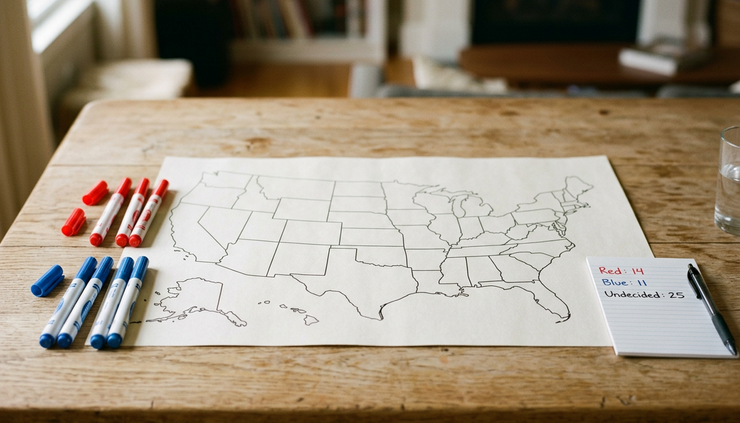
The difference between a claim and a demonstrated lead
Political boasting is easy. Demonstrating a lead is harder.
A candidate can say, “I would win easily.” A campaign can repeat it. Supporters can amplify it. Friendly media can treat it as obvious.
But elections are not decided by self-assessment. They are decided by voters, state by state, precinct by precinct.
That is why the distinction matters:
Declaring a landslide is not the same as showing one.
To support Trump’s claim, the numbers would need to show several things. They would need to show him leading Obama nationally. They would need to show him leading in enough competitive states to build a strong Electoral College advantage. They would need to show that his support was not just intense, but broad.
The polling described here shows the opposite on the first and most basic measure. Obama leads nationally in every cited head-to-head survey. The margins are not tiny. They range from clear to substantial.
From there, the AI simulation suggests that an Obama lead could produce an Electoral College result of 367 to 171. Again, that simulation is not an election result. But it is also not random. It follows from a premise that the polling makes plausible: Obama would begin such a hypothetical matchup with a real advantage.
That is the central problem for Trump’s boast.
He is not arguing from a close polling environment. He is arguing against the direction of the available evidence.
Polls are limited, but they are not meaningless
Any responsible look at polling has to include caveats.
Polls can miss. They can underestimate one side. They can shift quickly after major events. A hypothetical matchup involving two former presidents would be especially unusual because voters already have strong opinions about both men.
There is also no actual campaign. A real race would bring debates, ads, opposition research, economic conditions, court fights, world events, and turnout efforts. Both candidates would make mistakes. Both would try to shape the choice.
For that reason, the correct reading is not: “Obama would definitely win 367 electoral votes.”
The correct reading is: the numbers available do not support Trump’s claim that he would beat Obama in a landslide.
That is a narrower statement, and it is a stronger one.
The national polls give us actual voter responses. They show Obama ahead. The Electoral College simulation gives us a plausible state-by-state translation of that advantage. It shows Obama winning comfortably.
Together, they undercut the idea that Trump’s victory would be obvious, overwhelming, or easy.
A real pollster should test the matchup again
The most useful next step would be simple: poll the matchup again.
A fresh national survey would show whether the pre-midterm numbers still hold. Better yet, a set of state polls in key battlegrounds could show how the Electoral College might look under current conditions.
The questions should be straightforward:
If the 2028 presidential election were between Barack Obama and Donald Trump, whom would you support?
Are you certain, leaning, undecided, or open to changing your mind?
Which candidate do you trust more on the economy?
Which candidate do you trust more on democracy and constitutional norms?
Which candidate do you believe would handle foreign policy better?
Which candidate do you view more favorably?
Those follow-up questions would matter because a head-to-head number tells only part of the story. It shows the scoreboard. It does not fully explain why voters are choosing one candidate over the other.
A serious poll could reveal whether Obama’s advantage comes from personal popularity, nostalgia for his presidency, fatigue with Trump, concerns about stability, policy views, or some mix of those factors.
It could also reveal whether Trump has hidden strengths that a simple national number does not capture.
That is why new polling would be useful. It would either reinforce the existing picture or complicate it.
At the moment, though, the existing picture is not favorable to Trump’s claim.
The numbers tell a different story from the boast
Trump can say he would defeat Obama in a landslide. He can say Obama is overrated. He can insist that voters would choose him easily.
But the data cited in this hypothetical matchup point in the other direction.
The national polls from 2025 and early 2026 showed Obama ahead by 6 to 11 points. The January 2026 survey showed Obama leading 44% to 33%. The AI Electoral College simulation produced a 367 to 171 Obama win, a 196-electoral-vote margin.
None of that proves what would happen in a real campaign, because a real campaign cannot happen under current constitutional rules. It also does not replace professional polling, state surveys, or a full election model.
But it does answer the boast.
If Trump’s claim is that he would beat Obama in a landslide, the numbers presented here do not back him up. They show Obama leading nationally and winning the simulated Electoral College by a wide margin.
That leaves one clear takeaway: there is a considerable difference between declaring that voters would deliver a landslide and showing evidence that they actually would.
On this hypothetical matchup, Trump has the boast. Obama has the numbers.

Comments